

How to Charge for Social Media Management: Pricing Guide (2026)

Figuring out how to charge for social media management is one of the biggest challenges for freelancers and agencies. Charge too little and you burn out; charge too much without proof and you lose clients. This guide breaks down realistic pricing for every experience level, with concrete package structures you can adapt.
Quick Reference: Social Media Management Rates
Create content, post everywhere
Create captions, images, and videos with AI. Schedule to 9 platforms in seconds.
Start your free trial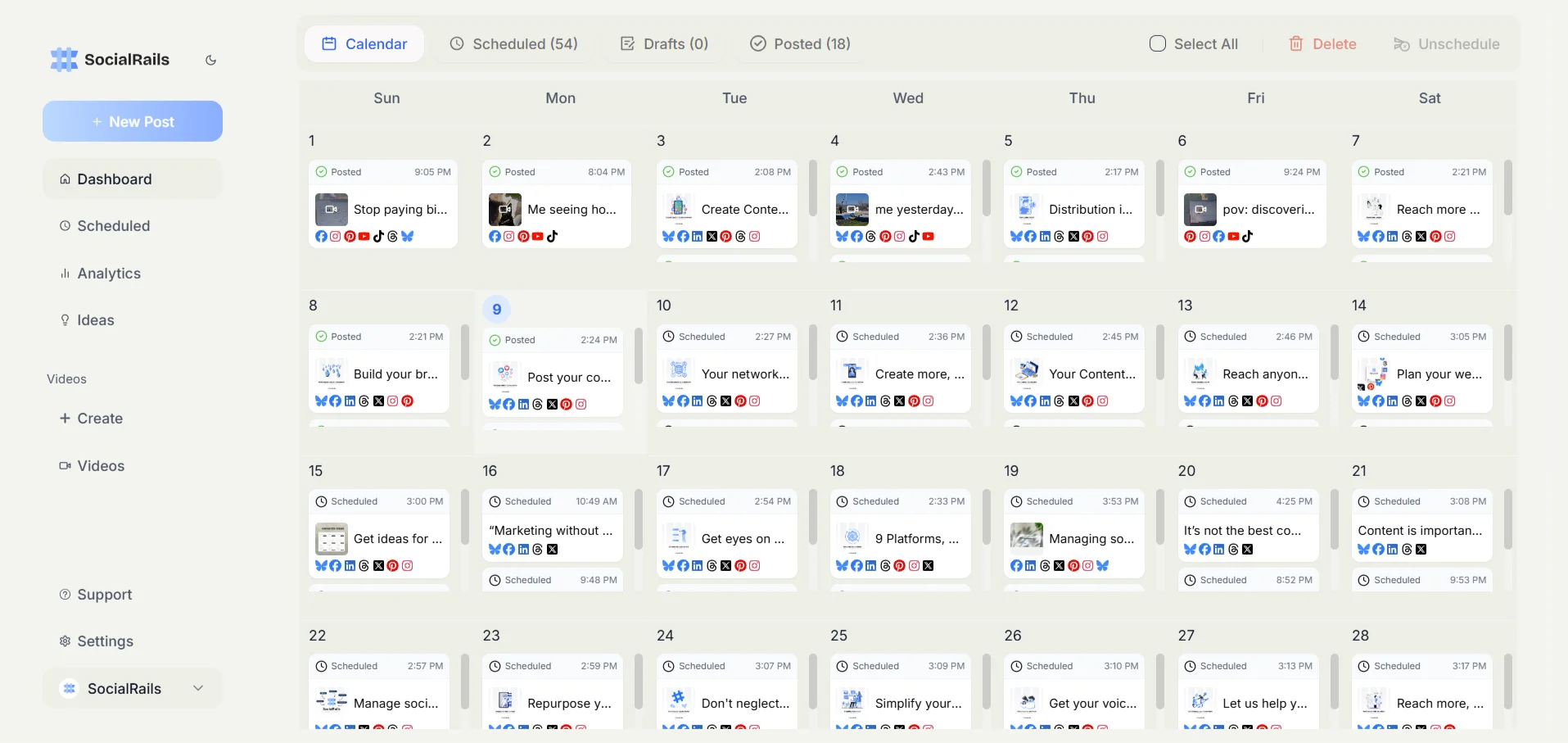
Most Common Model: Monthly retainer — provides predictable income for you and predictable budgeting for clients.
For detailed agency pricing structures, see our complete Social Media Marketing Agency Pricing Guide.
4 Pricing Models for Social Media Management
1. Monthly Retainer (Most Popular)
Fixed monthly fee for an agreed-upon set of ongoing services.
Pros:
- Predictable, recurring income
- Builds long-term client relationships
- Easier to plan and scale your workload
Cons:
- Requires a clear scope-of-work document upfront
- Can need contract adjustments as the client's needs evolve
Typical Retainer Rates:
- Small businesses (1-2 platforms): $500 to $2,500/month
- Medium businesses (3-4 platforms): $2,500 to $7,500/month
- Large businesses (5+ platforms, full strategy): $7,500 to $25,000+/month
2. Hourly Rate
Charge per hour of work completed — straightforward and transparent.
Pros:
- Fair for variable or unpredictable workloads
- Good starting point for newer managers
- Easy for clients to understand
Cons:
- Income fluctuates month to month
- Puts a ceiling on your earnings (trading time for money)
- Time tracking adds overhead
Typical Hourly Rates:
- Entry-level: $25 to $50/hour
- Experienced: $50 to $150/hour
- Expert consultants: $150 to $500/hour
3. Project-Based Pricing
Fixed fee for specific, defined deliverables with a clear start and end date.
Pros:
- Clear expectations for both sides
- Good for one-time needs like audits or strategy development
- Can be more profitable if you work efficiently
Cons:
- Scope creep risk if deliverables aren't well-defined
- Requires detailed contracts
Typical Project Rates:
- Social media audit: $500 to $2,500
- Strategy development: $1,500 to $7,500
- Campaign creation and launch: $2,500 to $15,000
- Account setup and optimization: $500 to $2,000
4. Performance-Based Pricing
Payment tied to measurable results — typically a base fee plus bonuses.
Pros:
- Aligns your incentives with the client's goals
- Can earn significantly more when you deliver strong results
- Attractive to ROI-focused clients
Cons:
- Risky if external factors affect results (algorithm changes, seasonality)
- Harder to predict monthly income
- Requires clear, agreed-upon metrics before starting
Common Structures:
- Base retainer + bonus for hitting KPIs (e.g., $2,000/month base + $500 when follower growth exceeds target)
- Percentage of ad spend managed (typically 10-20%)
- Cost per lead or conversion generated
How to Calculate Your Minimum Rate
Use this framework to make sure your pricing covers costs and pays you fairly:
Step 1 — Calculate your monthly costs:
- Desired annual salary ÷ 12 = $____
- Business expenses (internet, office, etc.) = $____
- Tools and software subscriptions = $____
- Set aside for taxes (~25-30%) = $____
- Total Monthly Costs = $____
Step 2 — Calculate your capacity:
- Hours you can realistically work per client per month: ____
- Maximum number of clients you can serve well: ____
Step 3 — Your minimum rate:
- Minimum Monthly Rate per Client = Total Monthly Costs ÷ Number of Clients
Example: If your total monthly costs are $6,000 and you can serve 5 clients well, your minimum retainer is $1,200/month per client. That's your floor — charge above this to build profit margin.
Service Package Tiers (Templates)
Here are package structures you can adapt for your own business:
Basic ($500 to $1,500/month)
- 3 to 5 posts per week on 1-2 platforms
- Basic graphics (templates, Canva-level)
- Hashtag research
- ~1 hour/day of community management
- Monthly analytics report
Standard ($1,500 to $3,500/month)
- Daily posting across 2-3 platforms
- Custom graphics and short-form video
- Content calendar with approval workflow
- ~2 hours/day of community management
- Competitor monitoring
- Bi-weekly performance reports
- 2 strategy calls per month
Premium ($3,500 to $10,000/month)
- Multiple daily posts across 3-5 platforms
- Professional content creation (photography, video, copywriting)
- Full community management and response handling
- Influencer outreach and coordination
- Paid social ad management
- Weekly performance reports and strategy calls
- Crisis management protocols
Enterprise ($10,000+/month)
- Dedicated account manager or small team
- All premium services included
- Custom content production (professional shoots, branded video)
- Multi-platform strategy with cross-channel integration
- Advanced analytics and attribution reporting
- Daily monitoring and real-time response
- C-suite reporting and stakeholder presentations
Platform-Specific Pricing Considerations
Not all platforms require the same effort. Factor this into your pricing:
Pricing tip: If a client wants TikTok and Instagram Reels management, this involves significantly more production time than managing a Facebook page or Twitter account. Price accordingly — video-heavy platforms typically warrant a 20-40% premium over text-based platforms.
Industry Premiums: When to Charge More
Certain industries require specialized knowledge, compliance awareness, or additional approvals that justify higher rates:
If you have specialized expertise in any of these areas, you have a legitimate reason to charge premium rates — clients in these industries need managers who understand their compliance requirements.
The Hidden Costs of In-House vs. Hiring a Freelancer
When a client says "that's too expensive," it can help to show them what the alternative costs:
Hiring an in-house social media manager:
- Salary: $40,000 to $70,000/year (varies by location)
- Benefits (health insurance, PTO, retirement): +25-35% of salary
- Payroll taxes: +7.65% of salary
- Tools and software: $200 to $1,000/month
- Training and professional development: $1,000 to $3,000/year
- Management overhead: time spent supervising, reviewing work
- Total real cost: $55,000 to $105,000+/year
Hiring you as a freelancer/agency:
- Your monthly fee covers all of the above
- No benefits, no payroll taxes, no training costs
- Client can scale up or down more flexibly
- Access to your experience across multiple clients and industries
This comparison helps clients understand they're getting a lot of value when they hire externally.
How AI Tools Are Changing Social Media Pricing in 2026
AI writing assistants, image generators, and scheduling tools have changed client expectations about what social media management "should" cost. Here's how to navigate this:
What AI can help with:
- Drafting initial caption ideas faster
- Generating image concepts and variations
- Scheduling and basic analytics reporting
- Hashtag and keyword suggestions
What AI can't replace:
- Brand voice development and consistency
- Strategic decision-making based on business goals
- Community management and genuine human engagement
- Crisis response and nuanced communication
- Understanding audience context and cultural sensitivity
- Creative direction and brand storytelling
How to position your value: Instead of competing with AI tools on content volume, emphasize the strategic, human, and creative aspects of your work. Clients who try to replace a social media manager with AI tools often find that the output is generic and doesn't drive real engagement or business results. Your expertise is in knowing what to post, when to post it, and why — not just producing volume.
Factors That Affect Your Pricing
Location
Major cities and high cost-of-living areas command higher rates. Remote work has narrowed this gap, but local expertise still matters for many clients.
Experience Level
Each year of experience, especially with proven results, justifies rate increases. Track your wins meticulously.
Industry Expertise
Specialized knowledge in regulated or niche industries (healthcare, finance, SaaS) commands premium rates.
Results Portfolio
Concrete case studies showing growth, engagement, or revenue impact allow you to charge more.
Service Scope
More platforms, content types (video, photography), and ad management all increase the value and price.
Client Size
Enterprise clients with larger audiences, more stakeholders, and higher expectations typically pay more.
How to Justify Your Rates to Clients
1. Show the ROI of Social Media Management
Present how your work delivers measurable value:
- Increased brand awareness (reach and impression growth)
- Lead generation (conversion tracking from social)
- Customer retention (engagement rates, response times)
- Sales attribution (revenue tracked to social channels)
- Time saved (what the client would spend doing this themselves)
2. Break Down What Goes Into Your Work
Clients often don't realize how much time social media management actually takes. Be transparent:
- Strategy research and development
- Content creation (writing, design, video editing)
- Community management and engagement
- Analytics, reporting, and optimization
- Tool costs and software subscriptions
- Ongoing education to stay current with platform changes
3. Share Your Best Results
Reference specific results from past work (with client permission):
- "Grew Instagram following from 2,000 to 8,000 in 6 months through organic content strategy"
- "Generated 150 qualified leads per month through LinkedIn content for a B2B client"
- "Reduced average response time from 12 hours to under 2 hours"
4. Compare to the Alternatives
Show the cost comparison:
- Full-time in-house hire: $55,000 to $105,000+/year all-in
- Large agency: $5,000 to $25,000+/month
- Your services: a focused, experienced option at a competitive price point
Handling "That's Too Expensive" — Negotiation Approaches
Here are practical ways to handle the most common pricing objection:
Approach 1: Reframe the value "I understand budget is a factor. Let me show you what this investment typically returns — for similar clients in your industry, we've seen [specific result]. What would that kind of growth be worth to your business?"
Approach 2: Offer a smaller scope "We can start with a smaller package focused on [one platform or core service] at $[lower price]. Once you see results, we can expand from there."
Approach 3: Show the cost of inaction "What's the current cost of not having consistent social media? How many potential customers are finding your competitors instead?"
Approach 4: Commitment discount "I offer a discount for a 6-month commitment — it gives me the stability to prioritize your account, and it saves you [X]% compared to month-to-month."
When to Raise Your Rates
Time for a Rate Increase?
Consider raising your rates when:
- You've been fully booked for 3+ months straight
- You have a waiting list of potential clients
- You've gained new skills, certifications, or platform expertise
- You can point to strong case study results
- You haven't raised rates in 12+ months
- Demand consistently exceeds your capacity
How to do it: Give existing clients 30-60 days notice. Apply new rates to new clients immediately. Consider grandfathering your best long-term clients or phasing in their increase over 2-3 months.
Common Pricing Mistakes to Avoid
1. Undercharging to Win Clients
- Competing on price alone attracts price-sensitive clients who are harder to retain
- Factor in ALL your costs — tools, taxes, health insurance, retirement savings
- Value your expertise. If you're good, charge accordingly.
2. Not Having Written Contracts
- Always use written agreements that define scope, deliverables, and payment terms
- Define what's included AND what constitutes extra work
- Include revision limits, response times, and cancellation terms
3. Allowing Scope Creep
- "Can you also manage our email newsletter?" is not part of your social media retainer
- Set clear boundaries on what services are included
- Have a process for quoting additional work
- Document all requests outside the original scope
4. Ignoring Local and Industry Market Rates
- Research what others in your area and niche are charging
- Tools like Glassdoor, job boards, and freelancer communities can help benchmark
- Position your pricing relative to the market — and be able to explain why
5. One-Size-Fits-All Pricing
- Different clients need different things. A local bakery and a national SaaS company have very different requirements.
- Offer multiple package tiers
- Allow customization and add-on services
- Price based on the value and complexity of each engagement
Additional Revenue Streams
Beyond monthly management, consider offering these as standalone services or add-ons:
- Social Media Audit: $500 to $2,500 (one-time assessment with recommendations)
- Training Workshops: $500 to $2,000 per session (teach client teams to manage their own accounts)
- Content Creation Only: $50 to $500 per piece (for clients who manage posting themselves)
- Strategy Consulting: $150 to $500 per hour (high-level guidance without execution)
- Paid Ad Management: 10-20% of ad spend (or flat fee for smaller budgets)
- Influencer Campaign Management: $1,000 to $5,000 per campaign
- Crisis Communication: $2,500 to $10,000 per incident (rapid response retainer or per-incident)
- Employee Advocacy Programs: $2,500 to $7,500 for setup and training
Tools to Streamline Your Services
Choosing the right tools helps you serve more clients efficiently. See our guide to the best social media marketing tools for agencies with detailed comparisons.
Ready-to-Use Pricing Templates
Simple Proposal Format:
Client: [Name]
Services: [#] platforms, [#] posts/week
Includes: Custom graphics, hashtag research, [#]hr/day management, monthly report
Investment: $[Amount]/month
Terms: Net 15, 3-month minimum commitment
Tiered Package Options:
Starter: $1,500/month — 2 platforms, 15 posts/month, monthly report
Growth:  $3,500/month — 3 platforms, daily posts, bi-weekly reports, ad support
Scale:   $7,500/month — 5 platforms, daily posts, full ad management, weekly reports
Regional Pricing Differences
United States
- New York / San Francisco / LA: $2,000 to $15,000/month
- Chicago / Boston / Austin: $1,500 to $10,000/month
- Mid-size cities: $1,000 to $5,000/month
- Small towns / Rural: $500 to $3,000/month
International Markets
- UK: £1,000 to £8,000/month
- Canada: CAD $1,500 to $10,000/month
- Australia: AUD $2,000 to $12,000/month
- India: ₹30,000 to ₹200,000/month
- Western Europe: €1,200 to €9,000/month
UK freelancers who want some help understanding the tax and finance side of self-employment can also find practical guidance through Hustle Mate.
Note: Remote work has made pricing more fluid. Many freelancers based in lower-cost regions serve clients in high-cost areas, and vice versa. Focus on the value you deliver rather than where you're physically located.
Negotiation Tips
- Start slightly higher — Always leave room for negotiation without going below your minimum
- Bundle services — Package deals feel like better value than individual line items
- Require minimum commitments — 3-month minimums protect both sides and give your work time to show results
- Set clear payment terms — Payment upfront or Net 15; avoid Net 30+ when possible
- Focus on value, not hours — Frame your pricing around outcomes, not the time you spend
- Be willing to walk away — Not every client is a good fit. Declining bad-fit projects protects your capacity for better ones.
Scaling Your Pricing Over Time
Year 1: Building Your Foundation
- Focus on building a portfolio and collecting testimonials
- Charge $500 to $1,500/month
- Take on 5 to 10 clients to get experience across industries
- Document every result for future case studies
Years 2-3: Establishing Your Reputation
- Raise rates based on your track record
- Charge $1,500 to $3,500/month
- Focus on 7 to 12 quality clients instead of volume
- Start specializing in 1-2 industries if possible
Years 4-5: Premium Positioning
- Position yourself as an expert with proven results
- Charge $3,500 to $7,500/month
- Maintain 5 to 8 high-value clients
- Consider subcontracting to handle additional work
Year 5+: Agency or Consulting Transition
- Build a small team to scale beyond your own hours
- Charge $5,000 to $25,000+/month per client
- Manage 15 to 30+ accounts with team support
- Explore consulting, training, or productized service models
Frequently Asked Questions
How much should I charge for social media management as a beginner?
Beginners with 0-2 years of experience typically charge $500-$1,500/month per client or $25-$50/hour. Start at the lower end while building your portfolio, but don't go below your calculated minimum rate. Undercharging makes it harder to raise rates later.
What pricing model works best for social media management?
Monthly retainer is the most widely used and recommended model. It provides predictable income for you and predictable budgeting for clients. It also incentivizes long-term relationships, which lead to better results for the client and more stable revenue for you.
Should I charge hourly or monthly for social media management?
Monthly retainer is generally better for ongoing work. It removes the pressure of tracking every hour and lets you focus on results. Hourly rates work well for consulting sessions, one-off projects, or when the scope is genuinely unpredictable.
How do I calculate my social media management rate?
Add up your desired annual income, overhead costs (tools, taxes, insurance, business expenses), divide by 12 months, then divide by the number of clients you can serve. This gives your minimum monthly rate. Charge above this floor to build profit margin.
What should be included in social media management packages?
Typical packages include content creation and posting, community management, hashtag research, analytics reporting, and strategy development. Higher-tier packages add paid advertising management, influencer outreach, video production, and more frequent reporting.
How often should I raise my social media management rates?
Review rates annually at minimum. Raise them when you've been consistently booked for 3+ months, have a waiting list, gain new skills or certifications, or can demonstrate stronger results for clients. Give existing clients 30-60 days notice.
What's the difference between agency and freelancer pricing?
Agencies typically charge $3,000-$30,000+/month because they have teams, overhead, and broader service offerings. Freelancers usually charge $500-$10,000/month with lower overhead and more personalized service. Neither is inherently better — it depends on the client's needs and budget.
How do I avoid undercharging for social media management?
Calculate your true costs (salary, taxes, tools, insurance, business expenses) before setting rates. Research market rates in your area and industry. Focus on the value and results you deliver, not just the hours you work. And don't lower your rates out of fear — confidence in your pricing reflects confidence in your work.
Was this article helpful?
Let us know what you think!