
Cross-Platform Content
Cross-platform content is one core idea intentionally adapted — not copy-pasted — across multiple social networks so it works with each platform's format, audience behavior, and algorithm. Done well, it multiplies the value of every piece of content you make.
Create content, post everywhere
Create captions, images, and videos with AI. Schedule to 9 platforms in seconds.
Start your free trial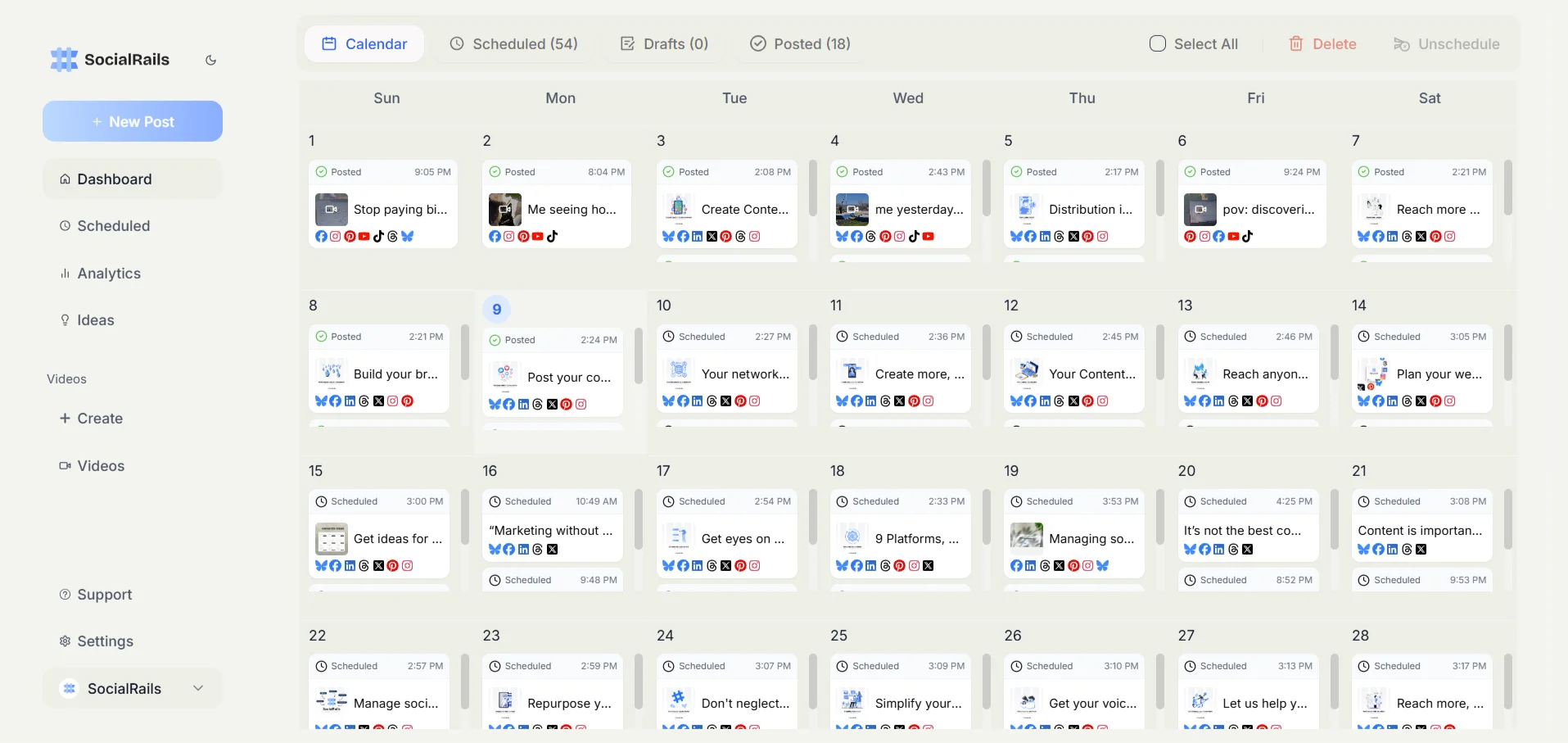
The short version: one idea, many expressions. A single concept becomes a LinkedIn long-form post, an Instagram Reel, a TikTok hook, a Twitter/X thread, a Facebook discussion, and a YouTube Short — each designed for how people actually behave on that network.
Why cross-platform content matters
Cross-platform content lets you reach different audiences from the same core work while the algorithm on each network still treats your post as native. Copy-pasting the same video to TikTok, Reels, and Shorts usually gets throttled because each platform can detect — and downrank — content that's obviously built for somewhere else. Adapting is the difference between 10× reach and being silently penalized.
The real benefits of a cross-platform approach:
- More output per hour of work — one long-form piece becomes 6–10 native posts
- Each network's algorithm treats your content as native, not recycled
- You reach audiences who don't overlap across platforms
- Reinforces your brand message through repetition across channels
- Lets you test what resonates and double down on the format that works
Quick Win
First step: Take your single best-performing post from the last 30 days and rewrite it for the 3 platforms you haven't posted it to yet — each one adapted to that platform's format, not copy-pasted.
Cross-platform content checklist
✅ Pick one primary platform you'll design the original asset for ✅ Define one core idea that fits in a single sentence ✅ Rewrite the hook for each platform — never reuse the same one ✅ Match format to platform (vertical video, carousel, long-form text, thread) ✅ Adapt caption length to what each network rewards ✅ Use native features — polls, Stickers, threads, Reels audio ✅ Schedule at each platform's peak time, not all at once
What "cross-platform" is not
Cross-platform content is not:
- Copy-pasting the same caption everywhere — that ignores how each network reads text
- Reposting a TikTok with the watermark to Reels and Shorts — both algorithms detect and deprioritize it
- One-size-fits-all aspect ratios — a 16:9 video looks like a square on mobile feeds
- Identical timing across platforms — peak hours differ by network and audience
The correct mental model is one message, many adaptations — not "one post, many channels."
The 5-step cross-platform content workflow
Step 1 — Start with your strongest platform
Pick the platform where you already have traction and design the "master" asset for that audience first. If you're strongest on LinkedIn, write the thought-leadership post first. If it's TikTok, shoot the vertical video first. Your best platform sets the quality bar.
Step 2 — Extract the core idea in one sentence
Before you adapt, answer: what is the one thing this post says? If you can't state it in one sentence, the post isn't ready to adapt — it's not clear enough yet.
Step 3 — Rewrite the hook for each platform
The hook is the first line, first frame, or first 2 seconds. This is the single most important adaptation. Platforms reward very different hook styles:
Step 4 — Match format to platform
Step 5 — Adjust caption length and tone per platform
The same idea should not ship with the same caption length everywhere:
Platform-specific adaptation rules
Adapting for LinkedIn
- Tone: professional, confident, insight-led
- Structure: hook → story → lesson → question
- Format: long-form text, document carousels, native video
- Hashtags: 3–5 industry-specific
- Best times: Tuesday–Thursday, 8–10am and 5–6pm local
Adapting for Instagram
- Tone: personal, aesthetic, narrative
- Structure: visual hook → caption hook → story → CTA
- Format: Reels dominate reach; carousels dominate saves
- Hashtags: 3–10 mixed broad + niche
- Best times: typically 11am and 7–9pm
Adapting for TikTok
- Tone: entertaining, direct, casual
- Structure: hook in first 2 seconds → payoff within 15 seconds
- Format: vertical video, trending audio, on-screen text
- Hashtags: 3–5 mixing broad and niche
- Best times: evenings and weekends typically strongest
Adapting for X / Twitter
- Tone: opinionated, concise, timely
- Structure: one claim → one supporting line → reply thread optional
- Format: short text post, thread for depth, reply-guy quotes
- Hashtags: 0–2 max (hashtags reduce reach on X)
- Best times: 8–10am and around news cycles
Adapting for Facebook
- Tone: conversational, community-friendly
- Structure: question or story → context → ask
- Format: image or short video; links suppressed in reach
- Hashtags: 1–2 max
- Best times: early afternoon, weekdays
Adapting for YouTube
- Long-form: hook in first 15 seconds, retention-optimized structure
- Shorts: vertical, under 60 seconds, on-screen text, clear promise
Adapting for Pinterest
- Tone: aspirational, keyword-driven
- Structure: vertical image (2:3) with text overlay → keyword-rich description
- Format: pins and idea pins
- Hashtags: secondary — keywords in description matter more
Adapting for Threads
- Tone: casual, community-focused
- Structure: short text post, reply-friendly
- Format: text-first; images and replies chain well
- Hashtags: light use, 1 per post
Content types that adapt well
Educational / how-to
- Core: a 3–7 step process
- LinkedIn: detailed text post with the full framework
- Instagram: carousel, one step per slide
- TikTok / Reels: fast-paced demo with on-screen text
- X / Twitter: thread with one step per post
- Facebook: longer narrative with a discussion question at the end
Behind-the-scenes
- Core: a snapshot of your process or day
- LinkedIn: lesson learned, framed as a takeaway
- Instagram: Story sequence with polls/questions + a Reel edit
- TikTok: short, music-driven process video
- Facebook: longer storytelling post
Customer story / case study
- Core: problem → solution → result
- LinkedIn: written case study with metrics
- Instagram: carousel with before/after visuals
- TikTok: a 30-second video of the customer in their own words
- Facebook: full narrative with discussion prompt
Thought / opinion
- Core: a take you'd defend in a conversation
- LinkedIn: structured argument with evidence
- X / Twitter: one-liner that invites debate
- Threads: casual framing of the same take
- Instagram: quote-card carousel
Product demo
- Core: feature → use case → outcome
- LinkedIn: written explainer with screenshot
- Instagram Reel / TikTok: fast screen-recording with voiceover
- YouTube Short: 30–60s tight walkthrough
- Pinterest: vertical how-to pin
What not to cross-post directly
Some content should not travel. Adapt it or don't post it:
- LinkedIn long-form articles — don't paste as an Instagram caption
- TikTok trending-audio videos — the audio rights don't transfer cleanly and the format will underperform on LinkedIn
- Instagram Stories — ephemeral and vertical with stickers; re-create natively
- Twitter/X replies and quote-posts — only make sense in the original conversation thread
- Real-time or news content — tone should be crafted per-platform
- Platform-native UI screenshots (e.g. DMs, threads) — often break trust on other platforms
- Personal content — may need different vulnerability for different audiences
Common cross-platform content mistakes
Identical captions across every platform
Each network rewards different caption lengths and tones. Copy-pasting signals "this isn't native" to both the algorithm and the audience.
Same aspect ratio everywhere
A 16:9 video made for YouTube looks cramped on a TikTok feed. Export the same idea in vertical (9:16), square (1:1), and horizontal (16:9) where needed.
Same posting time for every platform
Peak hours differ by network. Schedule per-platform windows, not a single blast.
Ignoring native features
Not using Instagram's Reel audio picker, LinkedIn's document carousels, or X's quote-post chain means your content reads as imported.
Leaving watermarks in place
TikTok watermarks on Reels, Instagram stickers on YouTube Shorts — algorithms deprioritize content with a competitor's watermark.
Posting everything on every platform
Not every idea belongs everywhere. A snarky X one-liner doesn't belong on LinkedIn. A corporate case study doesn't belong on TikTok.
Tools and scheduling for cross-platform content
The workflow that makes cross-platform realistic is one schedule, per-platform variants. Good tools let you:
- Write once, adapt per platform inside a single draft
- Schedule to different peak times per network
- Preview how each variant looks on the target platform before publishing
- Reuse hooks, captions, and hashtag sets from past winners
- See performance comparison across platforms for the same idea
SocialRails supports this workflow natively across 9 platforms — one calendar, per-platform adaptations, per-platform scheduling, and performance comparison across the same campaign. If you're running this playbook across several brand accounts at once, the how to manage multiple social media accounts guide covers the batching and naming conventions that keep it sane. If you want to compare options, see our content distribution tools guide.
Measuring cross-platform performance
Track the same idea across platforms to learn which format each network actually rewards for your audience:
Compare the same idea's performance across platforms, not just each post individually. That's how you learn which platform you should be leading with next time.
Cross-platform content FAQ
What is cross-platform content creation? Cross-platform content creation is the practice of building one core idea and intentionally adapting it to fit each social network's format, audience behavior, and algorithm — rather than posting the same asset everywhere.
What's the difference between cross-posting and cross-platform content? Cross-posting means publishing the same identical post to multiple networks. Cross-platform content means adapting the same idea into the native format of each network. Cross-posting usually gets throttled by algorithms; cross-platform adaptation doesn't.
How many platforms should I be on? Most small teams should focus on 2–4 platforms where their audience actually is, and adapt one idea across those. Being on every network with shallow content underperforms being on fewer networks with native content.
Can I repost the same video to TikTok, Reels, and YouTube Shorts? Technically yes, but you'll leave reach on the table. Each platform's algorithm can detect watermarks and non-native edits. Re-export each version without watermarks, adjust the caption and hook per platform, and match the audio rights for each network.
How do I adapt content without making 9 versions from scratch? Start with one "master" asset (long-form video or long-form post), then cut the hook, shorten the caption, and re-export for each platform. The core idea stays the same — only the expression changes.
What's the biggest cross-platform mistake? Using the same hook on every platform. The hook is the single most platform-specific element. A great LinkedIn hook is almost always a bad TikTok hook, and vice versa.
Cross-platform content is less about posting everywhere and more about designing one strong idea to survive the translation to each network. Lead with the idea, adapt the format — never the other way around.